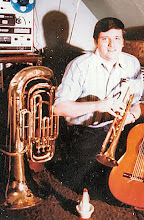
Taste of Louisiana Show on PBS, 1995 Christmas Memories Show. Pete shares a couple of his family recipes and toots Jingle Bells with Louisiana Chef John Folse. 10 minutes duration. Courtesy of LPB.org.
Showing posts with label New Orleans. Show all posts
Showing posts with label New Orleans. Show all posts
Saturday, December 19, 2009
Taste of Louisiana, Chef John Folse's Christmas Memories with Pete Fountain

Monday, October 12, 2009
The Basin Street Six - River Boat - Mercury Records
The Basin Street Six
River Boat
featuring Pete Fountain
River Boat
featuring Pete Fountain

 1951 Mercury Records EP-1-3238 Mono 7" EP
Side A:
1. Lazy River
2. I Can't Give You Anything But Love
Side B:
1. Sunday
2. Panama
Liner Notes:
Personnel:
George Girard (trumpet,vocals)
Joe Rotis (trombone)
Pete Fountain (clarinet)
Roy Zimmerman (piano)
Bunny Franks (bass)
Charlie Duke (drums)
Recording Date: Chicago September 19, 1951
In this Extended Playing album Mercury presents a genuine treat for jazz lovers in a sampling of the Dixieland which has brought quick fame to the Basin Street Six, a group of young musicians which Mercury believes is destined to become a legend in the jazz field. Jazz connoisseurs of long standing aver that this brand of music has not been heard since the days of the fabulous New Orleans Rhythm Kings. who remain, after many years, the criterion for excellence.
It is not by accident that the Basin Street Six has been compared to the New
Orleans Rhythm Kings. Like their great predecessors, the Basin Street Six came from New Orleans to Chicago and immediately created a sensation at such spots as Jazz Ltd. and the Blue Note. Their youth, vigor and obvious joy and talent in the music they play has brought them a fanatical following. In 21 year old George Girard on trumpet they have one of the most promising jass musicians to come along since the immortal Biz. The others, Pete Fountain on clarinet, Joe Rotis on trombone, Roy Zimmerman on piano, Charlie Duke on drums and Bunny Frank on bass, form a combination with Gerard that is the talk of the jazz world.
The four selections offered here are among the choicest in the Basin Street Six's rapidly expanding repertoire. You'll enjoy "Lazy River," played as we doubt you've ever heard it played before. Then there's "I Can't Give You Anything But Love," played tenderly yet with amazing variations which will leave you breathless with awe at their musicianship. "Sunday" is a gay romp, played with all the buoyancy and bounce this jazz standard calls for. "Panama" is a delight to anyone who appreciates authentic Dixieland.
Here, then. is the Basin Street Six, a young but musically mature group which has been called "the reincarnation of one of the first great jazz bands, the New Orleans Rhythm Kings."
Sunday, August 9, 2009
Memorabilia - Pete Fountain's Half Fast Walking Club by Brad Thompson
Pete Fountain's Half Fast Walking Club Poster
by Brad Thompson

Poster features legendary New Orleans jazz clarinetist, Pete Fountain, a founder and one of the most prominent members of The Half Fast Walking Club, one of the best known marching Krewes that parades in New Orleans during Mardi Gras. Foutain commissioned native New Orleans artist, Brad Thompson to paint "a collage of all that encompasses his part in starting 'the carnival' each year in New Orleans."
Size: 27" x 22" Unframed
Artist-Signed and Numbered Limited Edition Print
For more information or to purchase a poster:
http://www.usd.edu/smm/GiftShop/Posters/PeteFountainPoster.html
Memorabilia - Pete Fountain: The Duke of Dixieland - Jazz Times 2001
Pete Fountain: The Duke of Dixieland
Jazz Times Magazine, October 2001
by Geraldine Wyckoff

Pete Fountain appears a contented man as he sits in his homey office adjacent to his club in New Orleans’ Hilton Hotel. "Welcome to the inner sanctum," greets Fountain as he walks through a hall lined with photographs representing a lifetime in music.
A robust individual with shiny pink cheeks and a ready smile, Fountain, 71, glows with a sense of knowing just who he is, of being happy with his life and thankful for his many successes. He’s come a long way from the skinny asthmatic kid who, at the age of nine, took up the clarinet on the recommendation of a doctor. Because of his health problems, the physician advised Fountain’s mother to get her son a wind instrument to improve his respiratory system.
"Years ago they called it weak lungs," explains Fountain, who never again suffered with breathing difficulties. "It built up my lungs; in fact, they became over sized through the years."
The prescription, of course, not only cured the young boy but eventually led to a career spanning some six decades, over 90 albums and international acclaim. Music drew Fountain even before he ever put a clarinet to his lips. As a kid, he used to pass a club called the Top Hat on his way to the movies at the nearby Arcade Theater. He would stop to listen through the fence to bands with musicians like trumpeters Sharkey Bonano and Louis Prima.
"My sister would have to drag me along saying ‘Come on, we have to go to the show,’" remembers Fountain, who really preferred peeking through the slats and listening to the music. "I found out I really enjoyed jazz," he continues. "It was just the feeling of listening to the jazz like that, it just brings you up, even as a little kid. Something was there."
Fountain grew up in a mid-city New Orleans neighborhood. About a block and a half away was Peterson’s Music Store, a spot where Fountain would often hang out. The proprietor, Harold Peterson, encouraged the clarinetist in his endeavors and would have the boy get his horn and play for patrons of the store who he thought would enjoy hearing him.
"Mr. Peterson put together a little brass band, it was called the Broad Street Social and Pleasure Club. He would get everybody in the neighborhood who played. They’d stop by my house and pick me up. It was a school night and my mother used to scream about it. They wouldn’t walk too long. it would last as long as a barrel of beer lasted."
By the time Fountain was 14 he was already playing some dancehall jobs. "We had a little band and we’d get $5 a night," recalls Fountain. "There were four of us so we’d get $1.25. One of the guys, Jack Delaney, a great trombone player, would borrow his brother’s car to take us to the job."
Serious about music, Fountain listened to the clarinetists of the era like New Orleanians George Lewis, Raymond Burke and Irving Fazola as well as Benny Goodman. "I’m glad I did because I didn’t copy one particular clarinet player," says Fountain. "I put those four together and came up with a sound."
He developed his craft in ensembles like Phil Zito’s International Dixieland Express, The Dukes of Dixieland and the Basin Street Six. It was while with the Six, standing alongside childhood friend and music mate trumpeter George Girard, that Fountain realized his life’s work would be in music. "I went directly from high school to the Conservatory of Bourbon Street," says Fountain with a laugh.
With the Basin Street Six, Fountain played what he calls "swingin’ Dixie" and it’s a style he’s stuck with throughout his career. During the late 1940s, trumpeter Al Hirt would often sit in with the Six, and he and Fountain developed a life-long personal and musical relationship.
"From then on we got to be friends and we worked together a lot of times," says Fountain. "It was one of those things that whoever got the job wore the bow tie. If Al got the job he wore the bow tie; if I got the job I wore the bow tie. To work with Al, he was such a technician; he really helped me with my technique. Because to keep up with him, you’ve got to play because he’s not going to wait for you. He would kick off a tune and it was gone."
A glitch in Fountain and Hirt’s musical careers occurred in 1956, when the two musicians, who by then had family responsibilities, faced a scarcity of jobs. Blame it on the rise of rock ’n’ roll and rhythm ’n’ blues in their hometown; for the first time Fountain abandoned music as his main source of income. The two stuck together, however, and went to work for a pest-control company.
"He was in the roach division and I was in the termite division," says Fountain with a chuckle. "I was small and skinny at that time so I could get under a house. We didn’t last! I think we lasted about two months there. That was it."
Soon thereafter Fountain and Hirt both got the breaks that would completely change their fortunes. Hirt went with vocalist Dinah Shore and Fountain got the call from bandleader Lawrence Welk.
"She really made him and Welk really made me," says Fountain, who joined Welk’s band in 1957 and performed weekly on the bandleader’s popular television show. Fountain gained particular recognition on the program as he stepped out of the orchestra to lead a featured Dixieland combo that played classics like Muskrat Ramble.
Fountain initially went to Los Angeles to play with Welk for a couple of weeks but ended up staying two years.
"He kept me sober, and it damn near killed me," recalls Fountain, laughing. "He was pretty hard on drinking."
While Fountain was getting only union scale with Welk, he was gaining a strong following of fans and a reputation for his Dixieland style. He recorded an album with Welk and then debuted as leader on Pete Fountain’s New Orleans on the Coral label. (Re-released by MCA, Fountain says the album is still selling.) Now a household name and recording artist, Fountain felt his career was flourishing enough that he and his family could return home.
"I wanted my kids to grow up in New Orleans like I did," says Fountain. "Los Angeles didn’t have the heart and the warmth that you have down here. Even though my wife could cook red beans and rice, you miss the seasonings, you miss the crawfish and all of that."
Fountain, who has now been in the club business over 40 years, bought his first nightspot at 800 Bourbon Street. Playing three shows a night, five days a week wasn’t easy work, but was necessary because of the club’s limited capacity. Several years later, the clarinetist moved the action up the street to a larger spot at 231 Bourbon. Now Fountain had the luxury of having to play only two sets a night. In 1977, the clarinetist finally moved Pete Fountain’s to its present location on the third floor of the Hilton Hotel. Seating 400 patrons and designed by Fountain to resemble the Blue Room club in Las Vegas’ Tropicana hotel, the clarinetist and his band began packing them in for a single show a night. 
It’s a long way from Bourbon Street, and its heavy foot traffic, to the third floor of a downtown hotel. Realizing the problem from the onset, Fountain knew he had to let his fans across the country know where to find him when they came to New Orleans. He got in contact with The Tonight Show, then hosted by Johnny Carson, and asked to be a guest. The resulting performance served its initial purpose of advertising Fountain’s new locale and also became the first of 58 appearances on the popular late night television show.
With the release of 2001’s Big Band Blues (Ranwood), two of the most influential aspects of Fountain’s career appearances on Welk’s and Carson’s television shows came together. On the album, Fountain performs with the New Lawrence Welk Orchestra on arrangements by former Tonight Show guitarist Bob Bain. Through the years, Bain wrote these charts specifically for the clarinetist’s many appearances with the Tonight Show band, then led by Doc Severinsen.
In New Orleans, Fountain is renowned not only as a clarinetist and club owner, but also for his annual Mardi Gras appearances with his Half-Fast Marching Club. Since childhood, Fountain enjoyed watching and listening to Carnival organizations the Jefferson City Buzzards and the Corner Club. So in 1961, he and a group of friends formed their own marching club. The group of costumed revelers makes an annual trek from uptown New Orleans to the French Quarter, heading out on Carnival morning to walk in front of the famous Zulu parade. In Half-Fast’s early years, the Onward Brass Band accompanied it, led by drummer Paul Barbarin and later by clarinetist Louis Cottrell. For Carnival 2001, almost 200 people marched with the Half-Fast, which boasted two bands and, of course, Fountain’s clarinet.
"It’s New Orleans," says Fountain of this Mardi Gras experience. "It’s part of me; it’s part of my life."
As Fountain sits comfortably in his office, the walls full of photographs tell his story. Autographed pictures of stars like Frank Sinatra and Johnny Carson hang next to those of Fountain and his father costumed as Indians during one of the Half-Fast’s notorious marches. Fountain is at once the famed musician who played with trumpet legend Louis Armstrong and at the White House, and the guy who can’t resist hitting the streets for a second-line parade.
"I’m still here tootin’," says Fountain with a smile. "What you see is what you get."
About Geraldine Wyckoff

Geraldine Wyckoff has been a freelance music journalist in New Orleans for more than 22 years. She writes regularly for Louisiana Weekly and New Orleans Magazine. Geraldine has been contributing to JT since 1986.
http://jazztimes.com/articles/20111-pete-fountain-the-duke-of-dixieland
Monday, August 3, 2009
Review: The Roosevelt's Blue Room July 31, 2009 Show
The Roosevelt's reborn Blue Room
swings with Pete Fountain and Tim Laughlin
by Keith Spera, Music writer, The Times-Picayune
Saturday August 01, 2009, 2:33 PM
Reprint Courtesy of Nola.com © 2009 New Orleans Net LLC.
 Water glasses reflected blue stage lights. A massive chandelier sparkled. Elegantly attired guests dined on lobster and filet mignon and danced to a jazz big band fronted by the clarinets of Pete Fountain and Tim Laughlin.
 Take away the iPhones deployed by some and Friday could have passed for a scene from the Blue Room's heyday as one of the South's premier supper clubs.
Instead, Friday marked the rebirth of the Blue Room in The Roosevelt New Orleans, the sumptuously restored former Fairmont hotel on Baronne Street.
Photo right: Fountain "toots" at the opening of the reborn Blue Room on Friday, July 31, 2009. Kevin Zansler / The Times-Picayune
Back in the day, the Blue Room hosted all manner of marquee entertainers: Louis Armstrong. Frank Sinatra. Sonny & Cher. Tony Bennett. Ella Fitzgerald. Marlene Dietrich. Jimmy Durante. Bette Midler. For decades, until supper clubs fell out of favor, it was the place to see and be seen. Many New Orleanians harbor fond memories of special occasions spent there.
In its new incarnation, the room's layout is altered only slightly. Tables are set on two tiers, per tradition. But the low stage on which performers once ventured out among tables has been replaced by a herringbone-patterned dance floor. Musicians now occupy a raised stage set into the room's back wall.
 On the Blue Room's opening night, guests dined on lobster, caviar, filet mignon and baked Alaska. Kevin Zansler / The Times-Picayune
 But the elegance of the old days is in evidence. Many in attendance Friday could have frequented the Blue Room in the 1960s or earlier. With a $195 ticket, they passed through massive gold doors gift-wrapped with blue ribbons. Inside awaited memories and executive chef Stefan Kauth's menu of lobster and choupique caviar symphony, petit filet mignon, Louisiana crab cakes, truffle mashed potatoes and baked Alaska flambe.
Photo right: Tim Laughlin joined his friend and mentor Pete Fountain on stage for the reopening of the Blue Room. Kevin Zansler / The Times-Picayune
Laughlin and an expanded version of his band eased into a program of jazz standards and original material. The latter included "For Pete's Sake," a song Laughlin wrote in honor of Fountain, his friend, mentor and the night's special guest.
All musicians but Fountain wore tuxedos; he opted for a dark suit and tie. Bassist Matt Perrine, his long hair pulled back in a discrete ponytail, worked an upright bass furiously as he soloed in "When the Saints Go Marching In."
Men in suits and women in cocktail dresses crowded the dance floor. They kept dancing through the spiritual "Just a Closer Walk With Thee." "It's done in a tempo where you can get away with it," Laughlin said later.
After a final "Struttin' With Some Barbecue," fans pressed against the stage to shake Fountain's hand or collect an autograph on the blue souvenir menus. "The whole city loves you," one man said to Fountain.
Laughlin and Fountain return on Saturday, Aug. 1, for a second sold-out show. For the next few weeks at least, the Blue Room will open only for weddings and other private events. Starting in October, the room will feature a Sunday brunch, the restoration of another tradition.
 The 504-room Roosevelt, now part of the Hilton Hotel Corp.'s upscale Waldorf-Astoria portfolio, welcomed its first guests since Hurricane Katrina in early July. Laughlin has performed frequently in the hotel's refurbished Sazerac Bar. When a regular schedule of entertainment will return to the Blue Room itself is uncertain.
 Fans new and old will likely embrace it.
Fountain first played the room in the 1940s, and appeared dozens of times over the years. Laughlin attended a handful of shows at the old Blue Room, including the Mills Brothers and Mel Torme. But Friday was the first time he ever graced the stage himself.
"It was almost spiritual in a way," Laughlin said soon after the show's conclusion. "One of the biggest honors I've ever had. And to do it with Pete is a notch above that."
 The Blue Room's new herringbone-patterned dance floor, sparsely populated early on, filled up by the end of Friday's show. Kevin Zansler / The Times-Picayune
--------------------------------------------------------------------------------------------
Reprint and content courtesy of Nola.com © 2009 New Orleans Net LLC.
http://www.nola.com/music/index.ssf/2009/08/the_roosevelts_reborn_blue_roo.html
Sunday, July 26, 2009
Return of Entertainment to the Sazerac Bar and Blue Room
 After nearly 50 years, The Roosevelt New Orleans Hotel is again claiming its spot as a top music destination in the city and around the world.
On July 31, legendary clarinetist Pete Fountain will take the stage at The Roosevelt New Orleans Hotel's Blue Room, sharing the stage with fellow clarinetist Tim Laughlin. Together they will bring back the kind of star entertainment that once made the Blue Room one of America’s premier night clubs and supper clubs. The event will include a champagne reception and dinner starting at 7 p.m., with music to follow.
Once one of America's premier night clubs and supper clubs, The Blue Room will feature live music each Friday evening. The Roosevelt New Orleans Hotel will be opening its various attractions throughout the next month or so.
Sunday, July 5, 2009
Matt Litchliter Artwork - Teri Galleries, LTD. - Fine Art in Metairie, Louisiana
Matt Litchliter
Louisiana Artist
Pete Fountain Artwork
Pete Fountain Artwork
 Pete Fountain Original on Canvas
Co-signed by Matt Litchliter and Pete Fountain
 Matt Litchliter & Jazz Legend Pete Fountain
 Autographing the original appropriately titled "Pete Fountain".
It was an exciting day at Teri Galleries when Jazz Legend Pete Fountain visited to give his 'signature of approval' to New Orleans' artist Matt Litchliter's original painting of the internationally famous clarinetist! A collection of jazz fans and fine art investors were on hand to witness Pete Fountain and Matt Litchliter's meeting and autograph session. Although the original of Pete Fountain has sold, a limited edition run of giclee's on canvas are available.
Courtesy of http://www.terigalleries.com/litchliter.shtml
Jim Tweedy Artwork - Teri Galleries, LTD. - Fine Art in Metairie, Louisiana
Jim Tweedy
Louisiana Artist
Pete Fountain Artwork
 Hot Head Pete
 Little Pete Blue
 Red Pete
All original oil paintings on Canvas signed by Jim Tweedy & Pete Fountain
 Artist Jim Tweedy with Jazz Legend Pete Fountain,
autographing originals for art investors.
Courtesy of http://www.terigalleries.com/tweedy.shtml
Happy Birthday Pete Fountain! - Teri Galleries, LTD. - Fine Art in Metairie, Louisiana
Happy Birthday Pete Fountain!
Artwork by Jim Tweedy
Teri Galleries, LTD. - Fine Art in Metairie, Louisiana

Teri Galleries is celebrating the 79th birthday of their long time friend, Pete Fountain. Pete has been a huge part of what makes New Orleans so unique and his music has touched so many throughout his long career. Celebrate with us by purchasing one of the pieces that Pete's music inspired.
The embellished giclee' "Pete Fountain" by Louisiana artist Matt Litchliter captures that indelible spirit that is Pete Fountain as he plays during Mardi Gras and the during the procession of the Half Fast Walking Club. The series of original paintings done by another Louisiana artist, Jim Tweedy, have also been inspired by Pete Fountain. These pieces, both original and giclee's, show Pete's love of life and music in these fun representations.
These pieces as well as Litchliter's piece have been co-signed by Pete Fountain. If interested in either piece please contact Teri Galleries at 504-887-8588,1-800-533-8374 or via email at info@terigalleries.com
Courtesy of http://terigalleries.blogspot.com/2009/07/happy-birthday-pete-fountain.html
Sunday, May 31, 2009
Around the World for Lovers - Verve Records
Around the World for Lovers (Various Artists)
Featuring Pete Fountain
 2007 - Verve Records
 Track Listing:
1. A Foggy Day - Louis Armstrong
2. April In Paris - Sarah Vaughn
3. A Nightengale Sang In Berkeley Square - Anita O'day
4. Corcovado - Antonio Carlos Jobim
5. Dear Old Stockholm - Stan Getz
6. Do You Know What It Means To Miss New Orleans? - Pete Fountain
7. I Left My Heart In San Francisco - Arthur Prysock
8. Isfahan - Joe Henderson
9. Non-Stop To Brazil - Astrud Gilberto
10. When The Swallows Come Back To Capistrano - Carmen McRae
11. Manhattan - Blossom Dearie
Monday, May 25, 2009
Dr. John - Goin' Back To New Orleans - Warner Bros.
Dr. John - Goin' Back To New Orleans
featuring Pete Fountain


 1992 - Warner Bros
Tracks:
01. Litanie des Saints
02. Careless Love
03. My Indian Red
04. Milenburg Joys
05. I Thought I Heard Buddy Bolden Say
06. Basin Street Blues (featuring Pete Fountain)
07. Didn't He Ramble
08. Do You Call That a Buddy?
09. How Come My Dog Don't Bark When You Come 'Round
10. Good Night, Irene
11. Fess Up
12. Since I Fell For You
13. I'll Be Glad When You're Dead, You Rascal You
14. Cabbage Head
15. Goin' Home Tomorrow
16. Blue Monday
17. Scald Dog
18. Goin' Back to New Orleans
Line Up:
Dr. John (vocals, guitar, piano, organ)
Danny Barker (guitar, banjo)
Tommy Moran (guitar)
Pete Fountain (clarinet)
Charles Neville, Herb Hardesty, Eric Traub, Amadee Castenell, Frederick Kemp (Tenor Saxophones)
Alvin "Red" Tyler, Roger Lewis (Baritone Saxophones)
Al Hirt, Jamil Sharif, Charlie Miller, Umar Sharif, Clyde Kerr,Jr. (Trumpets)
Bruce Hammond (trombone)
Kirk Joseph (tuba)
David Barard, Chris Severin (bass)
Freddy Staehle (drums)
Alfred "Uganda" Roberts, Chief "Smiley" Ricks, Cyril Neville, Charles Neville (Percussion)
Shirley Goodman, Stephanie Whitfield, Connie Fitch, Tara Janelle, Chuck Carbo (Background Vocals)
The Neville Brothers: Art Neville, Aaron Neville, Charles Neville, Cyril Neville (Vocals)
Liner Notes:
Goin' Back traces a century of Crescent City musical history, starting in the mid-19th century with Louis Moreau Gottschalk, a classical composer influenced by the African chants and slave dances he witnessed in New Orleans' Congo Square. With support from some of the city's most prominent musical pioneers (including Danny Barker, Pete Fountain, and the Neville Brothers), Dr. John breathes new life into the work of Jelly Roll Morton, Louis Armstrong, James Booker, Professor Longhair, Fats Domino, Smiley Lewis, and Huey Piano Smith. From early jazz to junkie blues, Goin' Back covers it all, ranging from well-trod standards ("Basin Street Blues," "Careless Love") to otherwise forgotten jewels ("I Thought I Heard Buddy Bolden Say," "How Come My Dog Don't Bark"). What's most remarkable is how utterly alive and timeless it sounds. - Keith Moerer
Sunday, May 17, 2009
That's A Plenty by Pete Fountain - K-Tel
That's A Plenty
by Pete Fountain
 2009 - K-Tel Records
 Tracks:
1. That's A Plenty
2. Sensation Rag (Live Version)
3. In The Shade Of The Old Apple Tree (Live Version)
4. Up A Lazy River
5. Sunset In Paradise
6. Bayou Blues
7. Margie
8. High Society
9. The World Is Waiting For The Sunrise
10. Mahogany Hall Stomp
11. Farewell Blues
12. When The Saints Go Marching In
Liner Notes:
This is another one of those download only release on Amazon, old tunes from the Phil Zito, Tony Almerico, Sharkey Bonano, Santo Pecora and George Girard days. These songs seem to get repackaged over and over, same songs.
Bugle Call Rag & Other Favorites (Digitally Remastered) - EMG
Bugle Call Rag & Other Favorites (Digitally Remastered)
by Pete Fountain
by Pete Fountain

2009 - Essential Media Group LLC
Tracks:
1. Margie
2. Going Home
3. South Rampart Street Parade
4. That's A Plenty
5. Jazz Me Blues
6. Farewell Blues
7. Bugle Call Rag
8. High Society
9. When The Saints Go Marching In
10. Lazy River
11. The World Is Waiting For The Sunrise
Liner Notes:
This is one of those download only release on Amazon, old tunes from the Phil Zito, Tony Almerico, Sharkey Bonano, Santo Pecora and George Girard days. These songs seem to get repackaged over and over, same songs.
Tuesday, April 28, 2009
The New Orleans Jazz & Heritage Festival 2009 - News
The New Orleans Jazz & Heritage Festival 2009
Pete Fountain Performs on Sat April 25, 2009
Pete Fountain Performs on Sat April 25, 2009

Visit the official The New Orleans Jazz & Heritage Festival 2009 website.
 Pete onstage doing what he does best!
 Pete’s professional dancer and granddaughter, Danielle Harrell Scheib
 Pete behind the Economy Hall Tent after his set, saying "Hello".
Report from our very own blog member, thanks John!
The first weekend of JazzFest in New Orleans just concluded. New Orleans is now settling into a week of abundant night time club activity all over the city with jam sessions into the wee small hours. But last Saturday afternoon on the Fairgrounds in the Peoples Health Economy Hall Tent, Pete played an hour long set from 4:25 to 5:25.
He opened with “Clarinet Marmalade” and was greeted with a standing ovation before he played his first note. Other tunes included “Lazy River”, “Muskrat Ramble”, “Tin Roof Blues” with Allyn Young delivering an humorous blues vocal poking fun at trombonist Mike Genevay, and “Just a Closer Walk With Thee” after which the audience rose out of their seats to give a deserved standing ovation.
However, Pete had not played his full hand yet. Pete’s manager, Benny Harrell, announced that Pete’s professional dancer and granddaughter, Danielle Harrell Scheib, would accompany Pete and Band on “St. Louis Blues” supplying rhythmical patterns with her energetic tap shoes. A crowd favorite, Ms. Scheib stayed through the final number “When the Saints Come Marching In”. The weather cooperated with a sunny, pleasantly breezy day accompanied by blue skies and low humidity. JazzFest has one more weekend of music beginning this Thursday and ending next Sunday.
Sunday, March 15, 2009
Pete Fountain on the Lawrence Welk Show - Bootleg
Pete Fountain on the Lawrence Welk Show
5 CD Box Set March 1957 through March 1959


Liner Notes:
5 CD Box Set released 2009
Pete Fountain on the Lawrence Welk Show
Rare and Unreleased Records
March 1957 through March 1959
A rare find. over 170 recordings from Pete's time playing on the Lawrence Welk show. Carefully transferred from the original tapes and remastered, the sound quality is outstanding. Almost every recording Pete did on the Welk show, plus outtakes, airchecks, soundboard checks and dialog are included. As a bonus, some additional tracks from The Ed Sullivan Show, The Steve Allen Show, The Johnny Carson Show, The Bell Telephone Hour and the Kraft Music Hall are included.
Click on the below covers to see the track listing on each disc.


Saturday, March 14, 2009
Let's Get Acquainted - Brunswick Records
Let's Get Acquainted - The Lennon Sisters
featuring Pete Fountain
featuring Pete Fountain

 1958 - Brunswick Records BL 54031
Selections Include:
Side One
1. Let's Get Acquainted
2. Little White Lies
3. Young And In Love
With Orchestra Directed By Tiny Little
4. Teenage Waltz
With Orchestra Directed By Tiny Little
S. Pocahontas
6. White Silver Sands
With Pete Fountain And His Dixieland Boys
Side Two
1. When I'm With You
Featured In The Motion Picture "Poor Little Rich Girl"
2. One Day A Little Girl
With Pete Fountain And His Dixieland Boys
3. Walk With Me
4. If I Don't Love You
5. Shake Me I Rattle (Squeeze Me I Cry)
6. Goodnight God
Liner Notes:
The Lennon Sisters - Vocal Quartet With Instrumental Accompaniment
Let's get acquainted with the Lennon Sisters - Dianne, Peggy, Kathy & Janet - those four talented youngsters who sing their way into the hearts of millions of television viewers each week, via Lawrence Welk's network shows.
Representing half of Bill and Isobel Lennon's family of eight children there was always much to do around their Venice, California home. Singing together was the way the girls made their dishwashing chores lighter and their family duties more like fun than work. Humming lullabies and play-party songs together was a family affair in which the sisters took delight.
Perhaps some of their natural talent comes to them through their Dad. Bill Lennon had been a featured vocalist with the Paul Whiteman and Freddie Martin Bands in the early forties and for a time had a quartet with his brothers, Pat, Bob and Ted. As a protege of the famous tenor, Tito Shipa, he appeared in Hollywood Bowl concerts.
The girls first performed for friends and relatives and then went "on stage" at church benefits and civic functions. Fifteen-year-old Dianne's St. Monica's schoolmate, Larry Welk, Jr. "discovered" the sisters and got his famous dad to listen to them. Welk Sr. was so impressed with their charm and musical ability that he immediately signed them for a special ABC-TV Christmas show that was in preparation for the 1955 holidays. As soon as the nation's viewers saw them, Welk's judgement and Larry Jr's foresight were justified.
Billboard, the trade magazine of the music industry, published results of a disc jockey popularity poll shortly there-after and the Lennon Sisters were within the top ten most promising vocal groups. Noting this, Coral & Brunswick Records began making plans for offering more of their fine work on wax. Hence, several single releases, among them hits like "Tonight You Belong To Me" and "White Silver Sands" and now their first long playing album.
Despite tempting lucrative offers for outside engagements, the girls have remained loyal to their primary duties at home and with their schooling, limiting their professional work to recording and appearing as members of the Welk shows.
With no formal musical training, the girls do their arrangements seated at the kitchen table with a pitch-pipe as their only instrument. Mom helps them with the harmony and Dad coaches on phrasing and expression. Mom also designs and makes all their costumes.
Maestro Welk sums up their charm in the following statement: "They look sweet, sing sweet and have a certain intangible spiritual quality. It gets across to the audience."
Listen to these selections ...we're sure you will agree.
Sunday, February 8, 2009
Phil Zito and his New Orleans International City Dixielanders - Dixieland Express - Columbia Records
PHIL ZITO and his New Orleans International City Dixielanders
DIXIELAND EXPRESS (7" 45 rpm Box Set)


1951 Columbia Records Set B-199
7" - 45 rpm - 4 Record Box Set
Record One:
Side A: Bob Cats
Side B: Shine
Record Two
Side A: Bye and Bye
Side B: Original Dixieland One Step
Record Three
Side A: She'll Be Comin' 'Round The Mountain
Side B: Zito's Zag
Record Four
Side A: Clarinet Marmalade
Side B: Tulane Swing
Liner Notes:
PHIL ZITO and his New Orleans International City Dixielanders
Recorded in New Orleans
Personnel:
Phil Zito drums
Emile Christian bass
Roy Zimmerman piano
Pete Fountain clarinet
Joe Rotis trombone
George Girard trumpet
The upswing in Dixieland music that began to gather momentum during the last months of 1949 is happily serving a dual purpose. Not only is it introducing this "happy-making" music to generations almost entirely unfamiliar with it and bringing hack fond acquaintance to older enthusiasts, it is bringing recognition to a number of small groups that served faithfully and unceasingly during the Dixieland drought. Many of these groups, playing in nightclubs and theaters around the country, suddenly found that they were not, after all, playing mostly for their own amusement. They found that somehow the lively two-beat of their music had been taken up by a public weary of modernism and wary of over experimentation.
These records introduce such a group: Phil Zito and his New Orleans International City Dixielanders. Long-time favorites of New Orleans citizens, Zito and his organization have been heard at almost every musical event in that fascinating city. They have played in nightclubs, at jazz concerts and battles, at dances, in theaters, in parks and at all sorts of celebrations. Zito's first group, organized in the late Thirties, built up a considerable reputation with local fans, but was disrupted by the war. When Zito returned from the Navy, he again began building up a small combination, emphasizing Dixieland music, and swiftly became one of the leaders of the jazz movement in New Orleans.
As currently constituted, the New Orleans International City Dixielanders consist of comparative old timers in the rhythm section, with representatives of the younger musical generation in other spots. Zito himself is at the drums, Emile Christian plays bass, Roy Zimmerman piano, Pete Fountain clarinet, Joe Rotis trombone and George Girard trumpet. This is a festive outfit in the good old-fashioned New Orleans tradition. They put in plenty of time playing the usual round of engagements, but it is not uncommon to find them whooping it up at the opening of a new factory or spreading their music through the streets of the city to signal the premiere of a new film. If this is not precisely the clientele of the old jazz bands, it is at least the closest equivalent that these less rowdy days permit, and it carries their music directly into the daily existence of the lucky residents.
Eight samples of that vigorous brand are contained in this collection, some of them standard jazz exercises, some of them originals. In them is the happy compromise between high-flying solo work and closely-knit ensemble playing that distinguishes the New Orleans International City Dixielanders. Although their title may be a trifle cumbersome, there is nothing unwieldy about their music. Recorded in New Orleans, it has the special flavor of that city's contribution to popular music, bright, inventive and splendidly uncomplicated.
Wednesday, December 24, 2008
Dixieland Way Down Yonder In New Orleans - Southland Records
Dixieland Way Down Yonder In New Orleans

 1954 Southland Records SLP 214 Mono Only
Same LP was also published as "Jack Delaney & His New Orleans Jazz Babies" same catalog number, tracks and back cover and as "Way Down Yonder In New Orleans" (but not featuring Pete Fountain's picture on the cover). Both have different front covers. Southland commonly has two or three different covers for the same LP but featuring a different talent.
Side One
Jack Delaney, Trombone
Alvin Alcorn, Trumpet
Pete Fountain, Clarinet
Chink Martin, String Bass
Roy Zimmerman, Piano
Joe Capraro, Guitar
Monk Hazel, Drums-Mellophone
Playing
1. Shine
2. Sidewalks Of New York
3. Hindustan
4. Till We Meet Again
Side Two
Jack Delaney, Trombone
Raymond Burke, Clarinet
Lee Collins, Trumpet
Stan Mendelson, Piano
Abbie Brunies, Drums
Sherwood Mangiapane, Bass
Playing
1. Careless Love
2. Bucktown Drag
3. Who's Sorry Now
4. Basin Street Blues
Cover Design by Johnny Donnels
Liner Notes:
Dixieland from New Orleans: Naturally that's where it all started, back before the turn of the century. New Orleans - where the old time marching jazz came into being: Where Ragtime: Barrel House, old and present day Dixieland all originated: And the best Dixieland is still coming from this famous bend in the Mississippi.
Here's Recorded Proof.
The greatest names in jazz history were born right here in New Orleans. To name a few: Louis Armstrong, Johnny Dodds, Kid Ory, George Brunis, Paul Mares, Leon Roppolo, Irving Fazola, Eddie Miller, Monk Hazel, Santo Pecora, Lester Bouchon, Harry Shields. Every Crescent City boy hears so much music that he can't help developing a genuine interest in this Great Jazz.
There are always parades to inspire the kids. Jazz music is always with them, all year around, Dances, Parties, Celebrations. That's why so many New Orleans Jazz Men begin playing while they're still youngsters. Parents encourage the kids who show an interest in music - After all the older folks, too, have grown up in this parade-brass atmosphere.
It's little wonder that this environment must produce great jazz musicians. So here's real New Orleans-Dixieland music at its very best, and here is a veritable cavalcade of great New Orleans Jazzmen in two spectacular groups, each built around the young leader "Jack Delaney" and his unbelievable trombone. In the world of jazz a tasteful trombone is vital. Jack Delaney possesses all of the qualifications - tone, power, exceptional inventiveness. The ability to fit perfectly in the ensemble work, and a true tailgate style. We catch Jack on these sessions playing in three different styles: The Brunis Style, The Jack Teagarden Style and The Jack Delaney Style. No one enjoys playing more than Jack. He's got Dixieland in his heart. After you hear him on these sides you'll remember the name Jack Delaney, one of the next generation of great names in New Orleans Jazz. On side one you will hear the beautifully lyrical clarinet passages of Pete Fountain who will remind one of the late great Irving Fazola.
Opposite Pete Fountain we find the unique idea of the high-ranking Raymond Burke. On side one is the youthful sensation Alvin Alcorn from whose gleaming trumpet pours the whole tradition of the Crescent City, fine driving lead and exciting solos. On side two we find Lee Collins one of the jazz immortals who has been blowing the same kind of New Orleans horn for the past three decades - And better today than ever before. On piano side one we find Roy Zimmerman. Roy working freely and solid as we've rarely heard him. Onside two we find Stanley Mendelson a young man with old ideas, possessor of a truly great left hand, he has all the barrel house rock and a sincere and emotional style all his own.
Side one, Chink Martin using his string bass to perfection and lays down a big round tone. Side two we find the popular Sherwood Mangiapane; this bass-slaper deluxe would rather bleed to death than miss a beat. On side one we find Monk Hazel on drums and mellophone, Monk's name is famous where ever jazz is heard. Monk made a lot of music and still does. Monk Hazel heard on drums here, lays down a solid beat and plays more honest-to-goodness drums than you can find anywhere else in this hide beating generation. On side two we find the late Abbie Brunis on drums, drumming in good taste and his delicate handling of the rhythm is beautifully adequate. A special treat is the appearance of Joe Capraro on guitar on side one. Joe remains unchallenged in his mastery of the guitar and retains his enormous vigor and vitality after these many years. Joe maintains his position as a top Jazz Musician (after a lay off of twenty-five years) and is already for a hot session day or night.
Southland is proud of this album and proud to be able to work and record here in New Orleans, where session like this are possible and music can be made to delight the hearts of jazz lovers all over the world. After reading the multitude of wonderful reviews accorded Jack Delaney's heart warming horn on his first LP release we include these and other printed comments.
Particularly pleasurable is the full-tone expansiveness of Delaney's Tromhone." (Downbeat)
"Jack Delaney tracks are robust music played with a high degree of musicianship. His work on Southland is of high order. A big future for this boy." (Jazz Journal)
"Young Jack Delaney is improving with every week that passes. On South-land Records he can be heard playing delightful Trombone, easy swinging stuff in perfect taste, with a big tone and very original ideas. Jack is one of the most promising musicians in the states. A big future for this grand young musician." (Melody Maker: England)
"Jack Delaney's Trombone is mellow, round and big, It is very remindful of Miff Mole and Jack Teagarden combined. For such a youngster who is still learning, it is our prediction that this is the boy to watch. He's Got It, He Loves It, And he's not spoiled by the fuss that's being made over him." (Second Line - New Orleans Jazz Club)
"Jack Delaney is super extraordinary because that young man's syncopated ensemble blowing is outstanding, and this young man can really claim the singing tone. One of the finest Trombone men in the country today." (Alan C. Weber - Waterbury - Republican - Conn.)
- Joe Mares, Jr.
Monday, December 15, 2008
New Orleans Artists Against Hunger And Homelessness - Goodwin Music
New Orleans Artists Against
Hunger And Homelessness
featuring Pete Fountain
featuring Pete Fountain
 Front Cover
 Back Cover
 Inside Cover
 Side A is vocals, Side B is Instrumental
1985 Goodwin Music VPAG-101-GT
 Autographed Cover
 Newspaper Article About the Event.
-------------------------------------------------------------
Thanks to one of our blog members for sending this nice addition to the discography.
Subscribe to:
Posts (Atom)